aMOUR: recommending music by how it sounds
A music recommender that listens to the audio instead of looking at what other people played. Five music models, one benchmark, a web app to explore it all, and a stem experiment that didn't work.
Work in progress. aMOUR is a proof of concept, and it’s still moving. This article describes where it is as of October 2026. The parts that work, the parts that don’t yet, and what’s next are all at the end.
I’ve always had the feeling that I discover a lot of niche music and that the big platforms keep pushing me back toward the same popular stuff. That’s not a surprise: most recommenders are based on what other people listen to (collaborative filtering). If few people play a track, it barely gets recommended, whatever it sounds like.
So I wanted to try the opposite: recommend a track because it sounds like the ones I love, using only the audio. That’s aMOUR, a Music Oriented User Recommendation (and yes, the name came first).
Code: github.com/Epwo/aMOUR
The idea in one sentence
Turn every track into a vector with a model trained on music, then recommend the tracks whose vectors are closest.
audio ─► music model ─► one vector per track ─► nearest vectors = recommendationsEach track is cut into overlapping windows, each window goes through the model, and the results are averaged into one vector. For self-supervised models, I also average every hidden layer instead of only taking the last one: genre and mood information sits mostly in the middle layers.
Recommending is then just cosine similarity. No training, no user data from other people.
Which model “hears” music best?
That’s the real question of the project, so the code is built to swap the encoder easily. Every model is one small file implementing the same interface. I compared five of them (six counting the stem variant further down). All are trained specifically for music, except CLAP, a general audio–text model that stays as a baseline:
| Model | Who | Size of the vector | Notes |
|---|---|---|---|
| MuQ-MuLan | Tencent, 2025 | 512 | MuQ, aligned with text descriptions. Can also search by text. |
| MuQ | Tencent, 2025 | 1024 | self-supervised, beats MERT on most music benchmarks |
| OMAR-RQ | MTG-UPF, 2025 | 1024 | self-supervised on 330k hours of music |
| MERT | m-a-p, 2023 | 1024 | my first default |
| CLAP | LAION, 2023 | 512 | general audio and text, the baseline |
Benchmark
To compare them I use FMA-small, a dataset of Creative Commons music with genre labels (8 genres). I encoded 999 tracks with every model. The metric is simple: for every track, take its 10 nearest neighbours and count how many share its genre (precision at 10). By pure chance you’d get 0.125.
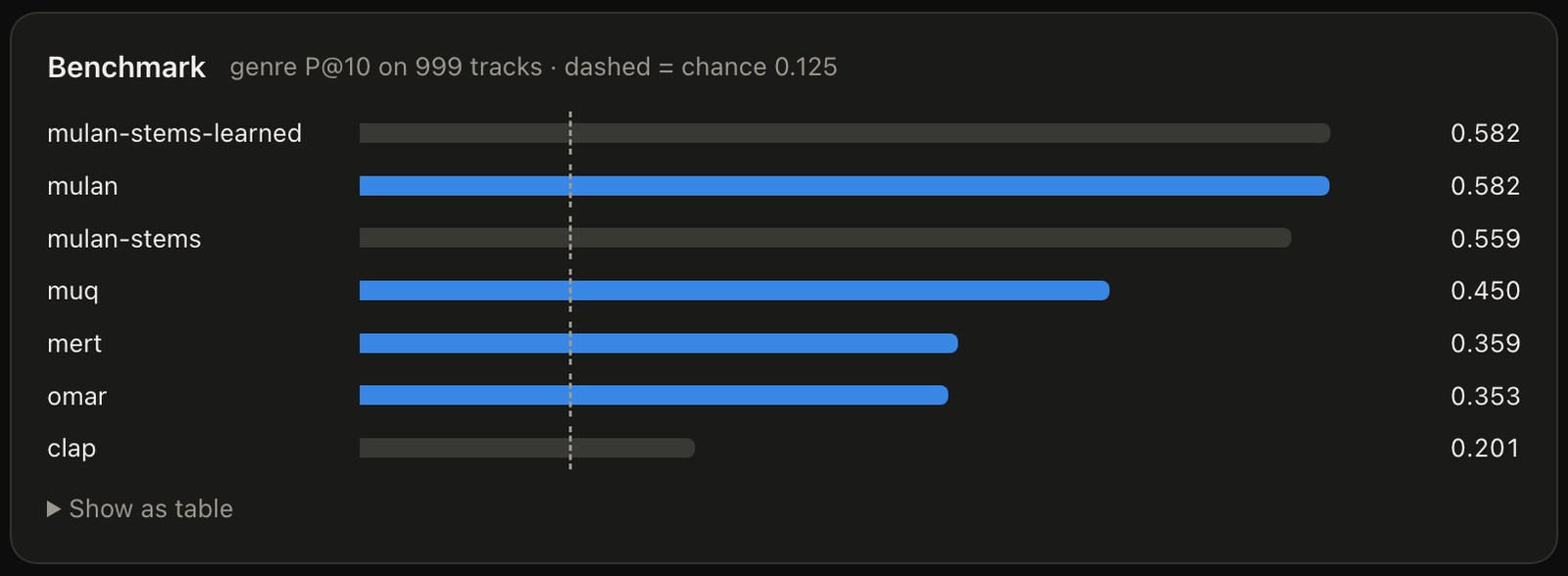
- MuQ-MuLan wins clearly, at 0.582. Training on text descriptions seems to teach it what humans care about in music.
- The pure self-supervised models (MuQ, MERT, OMAR-RQ) are well above chance, but behind.
- CLAP, the general audio–text baseline, is barely above chance at 0.201. Being able to tell music from speech or noise is not the same as knowing what makes two songs alike.
Genre is far from the whole story (“sounds similar” ≠ “same genre”), but it’s a cheap, objective first filter.
A web app to look inside
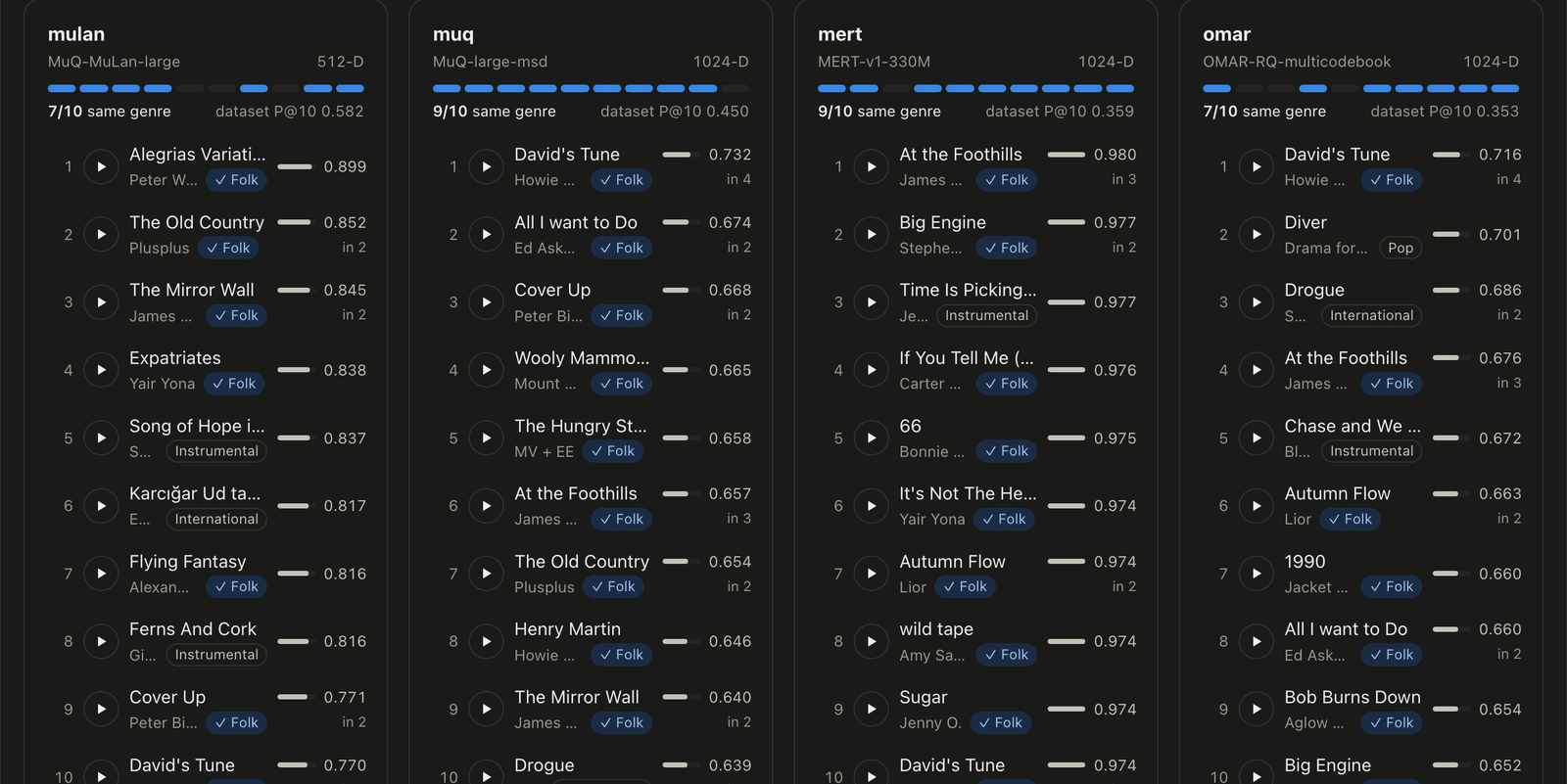
Numbers are nice, but I wanted to hear the results. So I built a small web app (FastAPI backend, plain HTML/JS frontend with no build step). You pick a track, by searching, at random or by clicking on the map, and you see the neighbours from every encoder side by side, with play buttons.
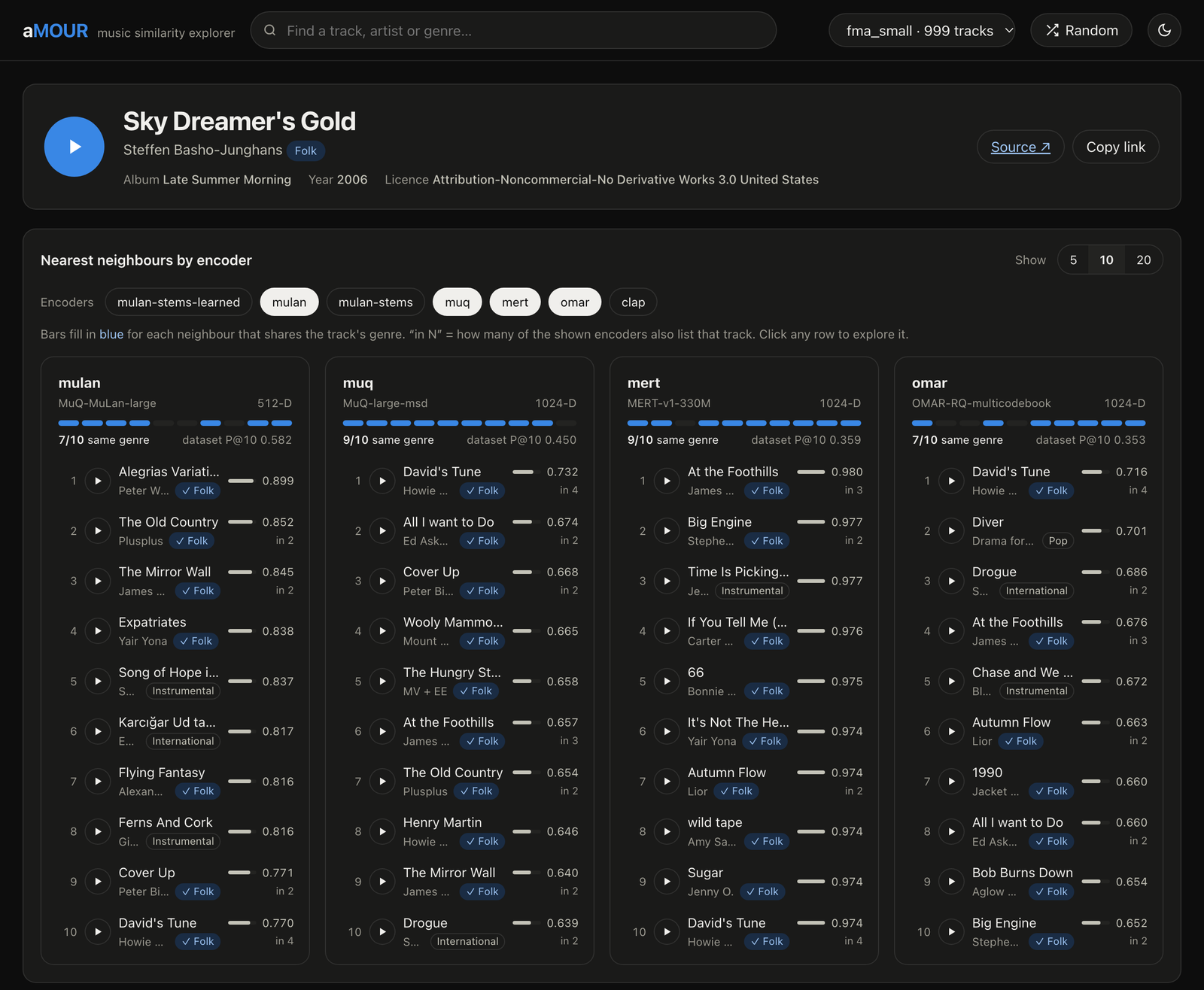
For each neighbour you get the similarity score, whether it shares the genre (the blue bars at the top of each column), and “in N”: how many of the other encoders also picked it. When three or four different models agree on a neighbour, it’s usually a really good match.
The whole state is in the URL, so I can send a link to a specific comparison.
Do the models agree?
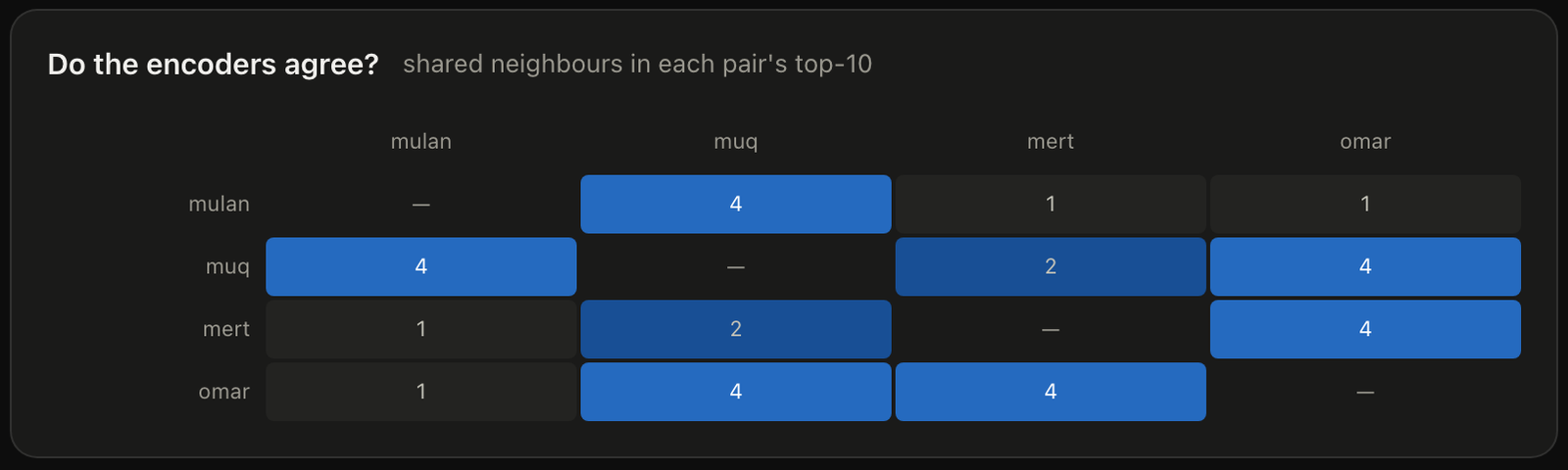
This grid counts how many neighbours each pair of encoders share in their top 10, for the selected track. On this folk track, MuLan only shares 4 neighbours with MuQ and 1 with MERT and OMAR, even though it scores best on genre. The models really do “hear” different things, which is exactly why comparing them side by side is interesting.
The map
The vectors have hundreds of dimensions, so to see them I project them to 2D with UMAP. Every dot is a track, the selected one is the diamond, its neighbours are numbered, and every track of the same genre is in blue.
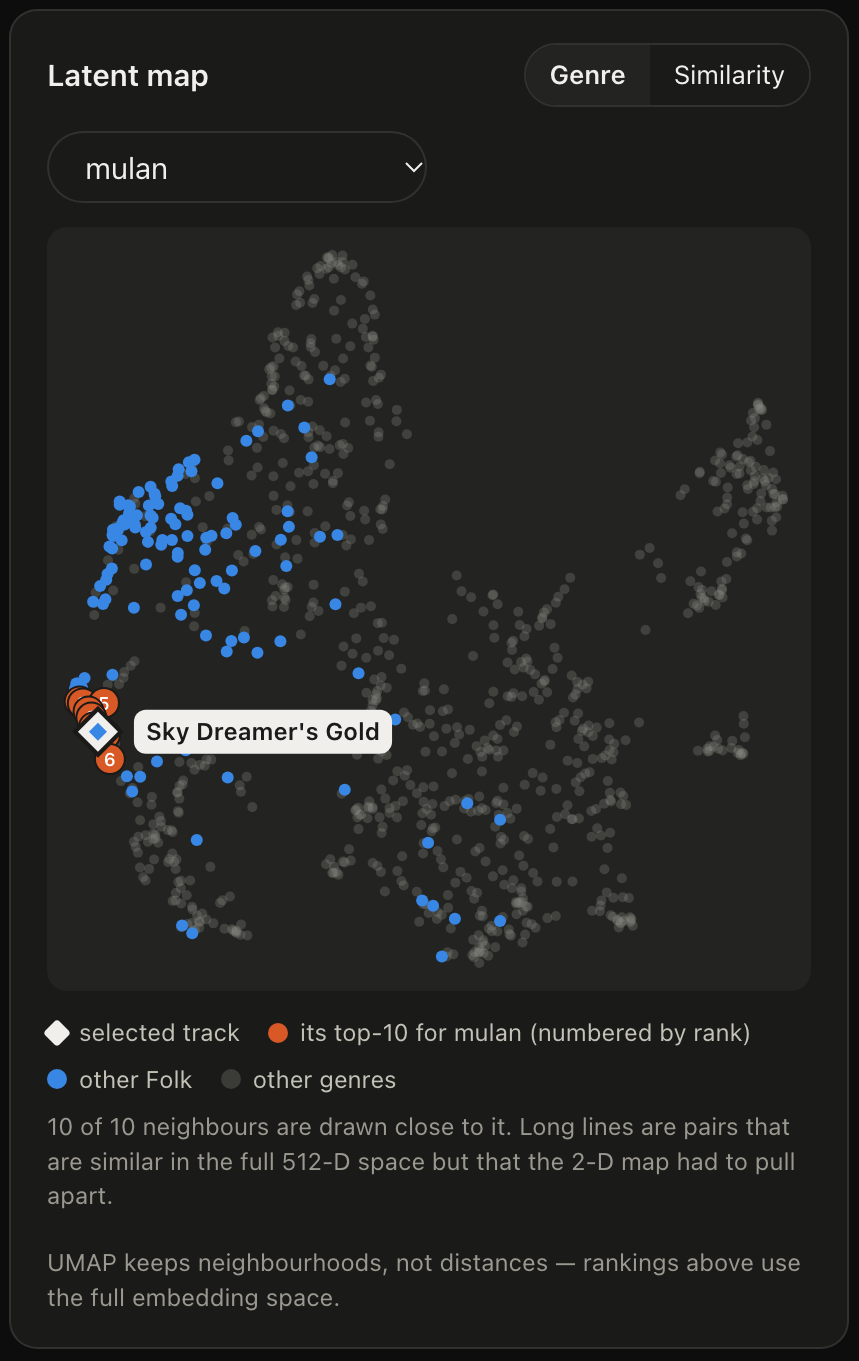
Here’s the same folk track on two maps, MuQ-MuLan on the left, CLAP on the right:
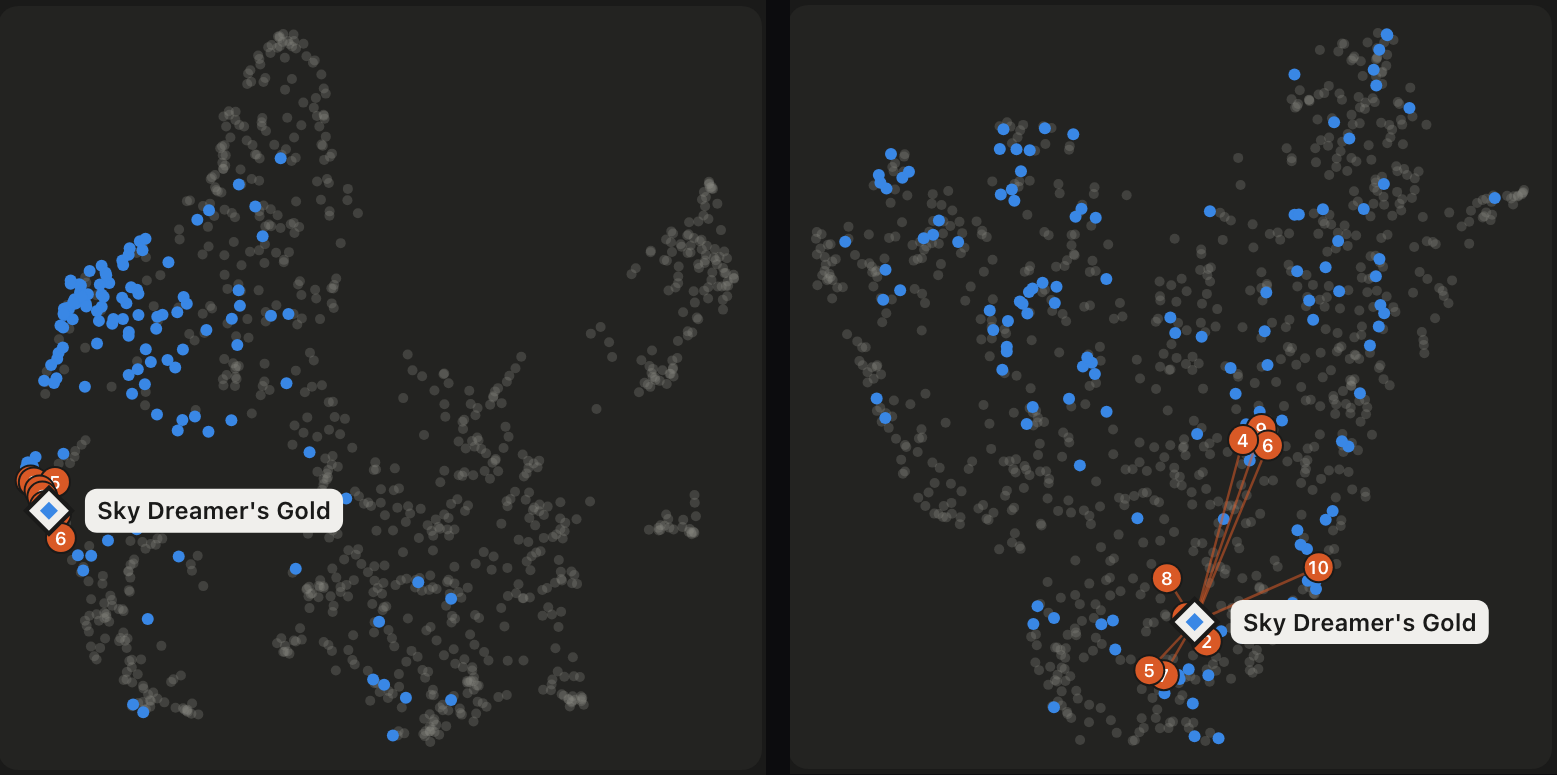
With MuLan, the folk tracks form a region and the 10 neighbours sit right next to the selected track. With CLAP, folk is spread everywhere and the neighbours are scattered across the map (the lines connect them to the selected track). That’s the benchmark, but visible.
There’s also a “Similarity” mode that colours every dot by its real similarity to the selected track. UMAP keeps neighbourhoods but not distances, so the map alone can be misleading.
My own music: importing listening profiles
FMA is good for benchmarks, but the goal is my recommendations. So aMOUR can import a listening profile:
- Deezer: any public profile, likes and playlists, with a lot of per-track details (BPM, release date, label, …). No login needed.
- Spotify: your own likes through the API, or anyone’s “Download your data” export. Spotify’s February 2026 API change removed access to other people’s profiles, so the export is the only way for those.
Deezer and Spotify don’t give you the audio, so the tracks are fetched from YouTube. That brought a lot of small fun problems: wrong matches (a video much longer or shorter than the real track, now detected by comparing durations and re-matched), live streams that never end, accents in search (“Beyoncé” vs “Beyonce”). My own Deezer profile is now 2,022 tracks encoded with MuQ-MuLan.
(Audio downloaded from YouTube stays on my machine for personal research; it’s never served publicly.)
An experiment that didn’t work: listening to stems
A recent paper (arXiv:2601.19109) reported that comparing tracks stem by stem (drums, bass, vocals, the rest) matches human similarity judgements much better than comparing the full mix. That sounded great, so I tried it:
- Split every track into 4 stems with Demucs.
- Encode the mix and each stem with MuQ-MuLan.
- Concatenate the 5 vectors, each with a weight, so the similarity becomes a weighted average of per-stem similarities.
- Learn the weights.
[ mix | drums | bass | other | vocals ] → 2560-DSeparation is slow (~2 s per track on the M4 GPU), so the stems are cached once on disk.
Result: on genre, the stems add nothing.
| Representation | P@10 |
|---|---|
| mix only (plain MuLan) | 0.582 |
| other / drums / vocals / bass alone | 0.455 / 0.408 / 0.382 / 0.315 |
| 4 stems, no mix | 0.529 |
| mix + 4 stems, equal weights | 0.559 |
| mix + 4 stems, learned weights | 0.582, with 96% of the weight on the mix |
| same, but tested on held-out tracks | 0.549 ± 0.018, vs 0.549 ± 0.019 for the mix alone |
When I let it learn the weights, it put almost everything back on the mix, and on tracks it hadn’t seen it did exactly as well as the mix alone. In hindsight, it makes sense: a genre label describes the whole mix, and the mix embedding already captures it. The paper measured something else, human perceptual similarity, where “same drum sound” or “same vocal timbre” matter on their own. Genre labels can’t teach that.
It’s still a useful negative result, and everything is ready to re-learn the weights from a better signal (see below).
What’s next
This is the “in progress” part:
- Learn from my taste, not from genres. The stem weights (and maybe a small re-ranking model) should be trained on my likes, or on “A is closer to B than to C” judgements, instead of genre labels.
- A taste vector. Average the vectors of the tracks I like, recommend around it, and refine it with likes and skips.
- Recommend outside my library. Right now it recommends within a dataset. The fun part is finding tracks I don’t know yet, which means encoding a much bigger catalogue, with a proper vector index (FAISS).
- Put the explorer online with the FMA dataset only. The backend and frontend are already separate for that. One constraint: the models’ licences are non-commercial, so it has to stay a free research demo.
What I’ve learned so far
- The encoder is everything. Same pipeline, same data: 0.20 with a general audio model, 0.58 with a music model trained with text.
- Build a tool to look at the results. The benchmark told me MuLan was better; the side-by-side view and the maps told me why, and made me notice how much the models disagree.
- Check what a paper actually measured. The stems paper wasn’t wrong. I was measuring something different.
- Getting the audio is half the work. Matching a Deezer track to the right YouTube video is a surprisingly deep rabbit hole.
More soon, as it moves!